May 21, 2013

More glibc crypt() fixes

Ever since glibc has introduced a new crypt() functions, some applications were broken and this batch of update should fix more packages, thanks to Mancha who has been helping out by testing and adding patches to work on this issues.

At long last, file is now upgraded to 5.14. This is the second attempt on upgrading file package as previous attempt broke other packages as well. Hopefully this time works as intended.

wqy-zenhei-font-ttf font is downgraded due to problems found and no exact solution for this. Let's just hope for upstream heard about this and fixed this problem. For now, downgrading is the best solution so far.

Security Updates: kernel

It's been a long time since Slackware released a security update for kernel packages, but since this update is critical (CVE-2013-2094, a bug that can allow local users to gain a root shell), Pat decided to take actions against it. He has released a new kernel packages available for both Slackware 13.37 and 14.0. Please note that Slackware-Current users are not vulnerable as this patches has been included in Linux Kernel 3.8.11 and we are using Linux Kernel 3.8.13.

Interesting updates comes in -Current as this batch upgraded a lot of things. Here are the highlights:
  • Upgraded GTK+ and all related libraries to the latest version
  • Upgraded GNOME related libraries to 3.8.x
  • aaa_elflibs is upgraded to 14.1 (confirms our next release is 14.1)
  • hplip is upgraded to 3.13.5
  • Removed kajong as it requires some new dependencies
  • Upgraded pcre to 8.32 (this requires a lot of rebuilt of packages)
  • Slacktrack is upgraded to 2.14
  • Upgraded XFCE related applications to 4.10.1
  • Upgraded more X related packages and libraries
  • Added several new packages
    • itstool (for gucharmap)
    • open-cobol
    • gnome-themes-standard (for GTK+3)
    • harfbuzz (for pango)
  • Handle IPv6 forwarding in network-scripts
A lot of people will be happy with these updates as Slackware current already includes most of the updated version available, thus compiling third party packages will be much easier.

As for MATE users, as there has been a change in dconf package, it's better to recompile all packages that are mentioned on CURRENT.TXT on our github repository. Thanks to Patrick for including this on Slackware-Current to ease our work in MATE SlackBuild project.

May 16, 2013

Security Update: Ruby

Another security update has been released and this time, Ruby package is update to the latest patch 429 to fix a security issue in DL and Fiddle included in Ruby where tainted strings can be used by system calls regardless of the $SAFE level setting. More detailed information can be seen here

Amarok 2.7.1 Released

Amarok is now upgraded to 2.7.1 after the developer has found an unpleasant bug between QtWebkit ↔ GStreamer interaction that made continuous playing almost impossible, due to frequent crashing. There were only 8 commits from the previous 2.7.0 and here are the highlights of this bugfix version:
  • A modification in handling MusicBrainz ID tags was needed to avoid problems with falsely duplicate tracks.
  • We fixed a weird behaviour when the "Use Music Location?" question is answered "Yes" on the first run.
  • We now have worked around the QtWebkit ↔ GStreamer bug that caused frequent crashes on track start; this happened if the Wikipedia applet tried to load a page containing an audio tag.
  • The database is now also created if the home directory contains non-ASCII characters.
  • The Nepomuk Collection now also shows track numbers.
  • Security Update: Firefox and Seamonkey

    Mozilla Firefox and Thunderbird are now upgraded to the latest stable version after they were released yesterday by Mozilla. Firefox is now at 21 which includes several new features which can be seen at their release notes.

    Rexima is now joining aumix in the pasture/ directory since it's no longer works with ALSA (only with compatibility module which turns to be disabled by default).

    kdelibs is patched to fix crashing when quitting KDE and some apps. Mozilla nss is upgraded to 3.14.3, while mesa is rebuilt using GCC instead of clang.

    May 15, 2013

    EFL 1.7.7 and Enlightenment 0.17.3 on SlackHacks

    I have pushed updates for EFL 1.7.7 and Enlightenment 0.17.3 which was released few days ago in the developer mailing list onto my SlackHacks repository. Everything works fine here, so i guess it would be safe to upgrade to this version.

    I have also upgraded connman to 0.14 and also switched econnman to git version. One note about econnman package is that this package is linked to icu4c-49 library, while Slackware-Current already moved to icu4c-51. So i added an ugly hack to create a symlink to make it work. Let me know if you have a better idea.

    Enjoy Enlightenment 0.17.3 and EFL 1.7.7 and please report any problems using my SlackBuilds :)

    May 14, 2013

    Listening Music on Linux Terminal / Console

    Most, if not all, people who use computer have ever or maybe always listen to music using their computer. It might become part of our routines, listening music while surfing net, chatting, gaming, writing documents / reports, or coding. There are many alternatives to music player. For Linux, one might recommend Amarok, other might suggest Banshee, and others might mention other application out there. It’s our decision to choose what player.

    For a hardcore people, they like to play music using their old black colored terminal. Well, some people might prefer GUI but this alternatives is not bad too.

    In this article we will discuss about alternatives to convenient music player (GUI) with Command Line Interface. Maybe not all of you like Command Line Interface, but this can be an alternative or maybe some knowledge.

    Here I present music player running on terminal. All of these player have been tested on Slackware64 14.0. There won’t be any installation step (yet) on this article, but might be covered on other article.

    Play

    Well, let’s start the list with Linux’s basic command for playing an audio file. It’s a simple command play we are talking about. To play a music, you can supply an argument which is path and filename to audio file we want to played. It then give you sound of what content on the audio. Well, there’s no interactive design and no playlist. Just a simple command to simply play a file.

    But wait, surely we want more than this, aren’t we? Well, if you want more, let’s talk about more Audio player to feed our curiosity.

    CMus (C* music player)

    Powered with NCurses, CMus is very powerful and highly configurable.

    Small, fast and support for UNIX-like operating system. It also features Vi-like commands and also configurable keyboard shortcuts which can be bound to other keys if needed. CMus is currently supports various audio format, including: Ogg Vorbis, FLAC, MP3 (with libmad), WAV, AAC, or WMA. Not to mention, it is lightweight and got good layout.

    It is a worth to try. You can go to their official site here.

    Mp3blaster

    An old and mature player. First released on 1997 it was known as Mp3player. A simple and humble name, well.

    Despite of the name, Mp3blaster supports several formats. Currently, they are: MP3, OGG, WAV, and SID.

    Like MCus, Mp3blaster also use NCurses. There is a panel on top of display, showing important keyboard shortcuts for playlist management. This pane is scrollable using + and -. On right side, there are ASCII art playback symbols such as |> as for play button. You can also press ? for detailed help.

    Keybindings is also configurable using a simple configuration file. Usually located at ~/.mp3blasterrc.

    You can visit their official site here.

    MPlayer

    Well, this player is well-known media player for their video capabilities. But who knows that this player also able to play lots of audio formats in Command Line Interface. It supports some formats, such as: OGG, Vorbis, MP3, WAV, AAC, FLAC, and WMA.

    Other interesting information can be found on their official site, here.

    MOC

    Well, it has simple name behind it. MOC, or Music On Console. It is a good choice for music libraries that consist of OGG, WAV and MP3 files. It’s easy to use out of the box, boasting a two-paned interface similar to that of Midnight Commander, with a file browser on the left and your playlist on the right. The default keybindings are mostly use single letter for what function they represents. For example, you can press N for “next track” and R to toggle random play.

    In term of configuration, it is also configurable. Just edit ~/.moc/config file to do some adjust like colors, width of each window pane, etc.

    MOC can be further viewed on their official site, here.

    MPD + Ncmpcpp

    Music Player Daemon (MPD) could be considered a giant software in Linux audio. It comes preinstalled in many distributions.

    Technically speaking, MPD is a server-side application. Can we call it as back end program? It’s great for setting up networked audio in a home media center. We also can use it simply for local playback. The advantage here is that we can use any client you want to control MPD, and there are many client to choose.

    Next to Ncmpcpp. This is an Ncurses MPD client, based on Ncmpc but more advanced. Well, that’s why it is called as Ncmcpp, if you know what I mean :D

    Ncmpcpp includes support for Last.fm scrobbling and music visualization via external libraries. Lyrics fetching and display are built in and can be activated for a selected track by pressing l. Ncmpcpp can fetch artist information as well.

    Although Ncmpcpp is terrific once we get it set up, using an MPD client to listen to music isn’t always a pragmatic choice. You’ll most likely be up and running much faster with a player like Mp3blaster, MOC or Herrie.

    MPD can be found here.

    Ncmpcpp can be found here.

    nvlc

    Have you ever heard VLC?

    The famous VLC media player is known for its ability to play almost media file you give. The terminal version comes with a lesser-known Ncurses control interface. To start it up, type nvlc. The interactive features are noticeably limited in comparison with the vast array of options you may be used to seeing in the GUI version. Press B to browse your files and Return to add a file to the playlist. Toggle help view with h for a complete list of hot keys.

    It might be unattractive at first time you see it. Well, that feeling comes to me too. If you search for  a preconfigured player with lot of hot keys, then it might not be what you search for. But you can do a lot of experiment with it, including adding custom hot keys. Well.

    Now, CLI-lovers, this is what you may like about nvlc. The power of nvlc lies on Command-Line arguments. You can pass arguments ranging from a directory or a playlist to complex chains of filters. Anything you can do in the GUI version of VLC is possible with nvlc if you know the right argument to pass.

    Now, let’s warm up our fingers and experiment with these snippet:

    # getting help
    nvlc -h
    nvlc -H
    
    # Play music on a directory
    nvlc /path/to/my/music
    
    # List what modules avilable
    nvlc --list
    nvlc --list-verbose
    
    # Now, try this
    nvlc --audio-filter chorus_flanger --delay-time 150 --dry-mix 0.8 --wet-mix 0.6 --feedback-gain -0.3 /path/to/my/mysic.fileextension
    

    Here you can find VLC.

    Herrie

    It means “clamour” in Dutch. Herrie was first released in 2006.

    If you look at it, it has simplest design after all. Well, nohing I can say about this program. Well, Last.fm users likely to find it easy to use and easy to set up track scrobbling. Since I’m not on Last.fm so I can say much. Here, you can explore it deeper.

    Herrie can be found at their official site, here.

    tcl and samba upgraded

    Patrick removed two packages from the main tree: aumix (moved to pasture since only works with OSS or with ALSA compatibility modules, which is disabled by default) and quanta (no longer build with newer version of kdevplatform).

    Meanwhile tcl and tin was upgraded to the latest version after being requested on LQ. The same goes with Samba which is now at 4.0.5, taking a big jump from 3.6.8 and ccache with 3.1.9.

    Due to this changes, several other packages will need to be rebuilt such as Python, Ruby, pil, pidgin, xchat, expect, hfsutil, and tix.

    May 13, 2013

    Kernel Updated to 3.8.13

    Patrick is updating the default kernel stock in Slackware-Current to the latest and last stable kernel update for 3.8.x branch as Greg has stated that Linux Kernel 3.8.x is now EOL'ed unless someone is willing to take this branch into a longterm kernel.

    Config files for previous long term stable kernel (3.4.45) is also provided in testing along with the latest stable kernel for 3.9.x branch (3.9.2). Users who prefer to use other kernel version rather than 3.8.x can use the config files to build their own kernel package.

    May 12, 2013

    Current State of VMWare Workstation and Player

    I have mentioned before that you should avoid upgrading to Linux Kernel 3.9 and GCC 4.8.0 if you are using any VMWare products (Workstation or Player) since this combination may break the modules recompilation.

    There are 'safe' combination if you want to VMWare Workstation/Player:
    • Linux Kernel 3.8.x and GCC 4.8.x
    • Linux Kernel 3.9.x and GCC 4.7.x
    Since Patrick decided to stick with the first option, i'm fully agree with this option, since it fits with the first option and VMWare Workstation/Player should work on next Slackware release out-of-the-box. No patches needed!! Simply the ideal condition for any users out there :)

    Update 1: Luigi Trovato has mentioned that he has successfully built VMWare Workstation 9.0.2 on Linux Kernel 3.9.2 with GCC 4.8.0 and it worked. I'm currently downloading Linux Kernel 3.9.2 and will compile it to try it out. I was using Linux Kernel 3.9.0 and didn't try other version.

    Update 2: I have successfully compiled Linux Kernel 3.9.2 and i can confirm that this version does work with VMWare Workstation 9.0.2 and GCC 4.8.0. I didn't see any changes within the vmci source code, but apparently it worked now, so you can use both Linux Kernel 3.8 or 3.9 along with GCC 4.7.3 or 4.8.0 combination.

    May 11, 2013

    LibreOffice 4.0.3 for Slackware Users

    Eric Hameleers has built the latest LibreOffice 4.0.3 for Slackware users. The package is built for Slackware 14.0, but they are usable for Slackware-Current users as well. For those who are still running Slackware 13.37, you should stick with the 3.6.6 release or upgrade to Slackware 14.0 to enjoy the current version of LibreOffice.

    He has also managed to provide updates for steam client and several other packages in his repository. Check the ChangeLog for more information about updated packages.

    May 08, 2013

    KDE 4.10.3 on Slackware-Current

    Patrick Volkerding has just pushed KDE 4.10.3 for Slackware-Current. Usually Eric did the push on his KTown, but since KDE 4.10.x has been included in Slackware-Current, Pat took the responsibility of building the packages, while Eric may provide updates for Slackware 14.0 users.

    Besides KDE 4.10.3, several packages gets rebuilt to add patches such as alsa-lib, clucene, and ncurses.

    Enjoy KDE 4.10.3 on Slackware-Current :)

    May 06, 2013

    Kernel Upgraded to 3.8.11

    The latest stable kernel 3.8.11 has just landed on Slackware-Current along with timezone database update, thus a rebuilt for glibc is needed. Although Linux Kernel 3.9 has been released, Linux Kernel 3.8.x branch is not yet abandoned by Greg and it will be used on the next Slackware release if nothing breaks during development.

    The only package outside kernel and glibc is gnuchess which is now at 6.0.3

    May 05, 2013

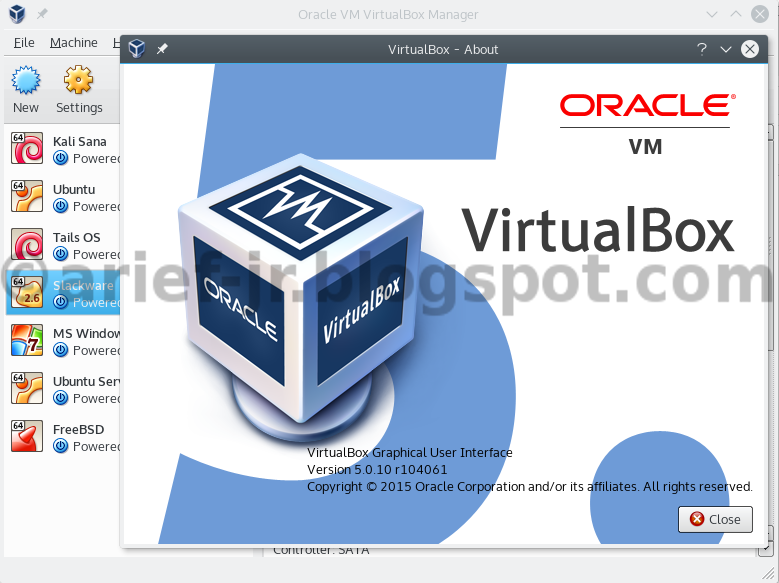
    VBoxwrapper

    Post ini sebenarnya pemekaran dari post lama, jujur aja, saya lupa apa yang harus dilakukan ketika ingin menggunakan VirtualBox dan GNS3. Catatan lama pun telah menjadi serpihan yang tenggelam diantara tumpukan file lainnya. :P

    Oke, dianggap kita telah berhasil melakukan installasi GNS3 terbaru tanpa masalah. VirtualBox yang digunakan sangat disarankan adalah versi OSE. VirtualBox yang siap pakai memiliki permasalahan pada pemuatan modul VBoxPython. Padahal path installasinya sudah di /usr/lib/python loh.

    # export VBOX_INSTALL_PATH=/usr/lib/python2.7
    # python vboxapisetup.py install
    running install
    running build
    running build_py
    creating build
    creating build/lib
    creating build/lib/vboxapi
    copying vboxapi/VirtualBox_constants.py -> build/lib/vboxapi
    copying vboxapi/__init__.py -> build/lib/vboxapi
    running install_lib
    copying build/lib/vboxapi/__init__.py -> /usr/lib/python2.7/site-packages/vboxapi
    byte-compiling /usr/lib/python2.7/site-packages/vboxapi/__init__.py to __init__.pyc
    running install_egg_info
    Removing /usr/lib/python2.7/site-packages/vboxapi-1.0-py2.7.egg-info
    Writing /usr/lib/python2.7/site-packages/vboxapi-1.0-py2.7.egg-info
    $ python
    >>> from vboxapi import VirtualBoxManager
    >>> g_Vboxmgr = VirtualBoxManager(None, None)
    Traceback (most recent call last):
      File "<stdin>", line 1, in <module>
      File "vboxapi/__init__.py", line 514, in __init__
        exec "self.platform = Platform"+style+"(platparams)"
      File "<string>", line 1, in <module>
      File "vboxapi/__init__.py", line 350, in __init__
        import xpcom.vboxxpcom
      File "/opt/VirtualBox/sdk/bindings/xpcom/python/xpcom/vboxxpcom.py", line 47, in <module>
        raise Exception, "Cannot find VBoxPython module"
    Exception: Cannot find VBoxPython module
    >>> import VBoxPython
    Traceback (most recent call last):
      File "<stdin>", line 1, in <module>
    ImportError: VBoxPython.so: undefined symbol: PyUnicodeUCS4_DecodeUTF16

    Saya sempat melakukan compile terhadap Python 2.7 untuk mengaktifkan UCS4. Namun ketika berhasil mengimpor VBoxPython. PyQT menjadi bermasalah. Dapat dimungkinkan PyQT ini di compile dengan python opsi UCS2. Ada dua cara, cara pertama re-compile PyQT, GNS3 dan VirtualBox mungkin dapat berjalan, namun apa jadinya dengan aplikasi lainnya? dan bagaimana jika terdapat pembaruan paket Slackware? re-compile? Oh tidak! Cara kedua adalah re-compile VirtualBox. Saya pilih cara kedua. Dengan melakukan compile sendiri, VirtualBox-lah yang seharusnya disesuaikan dengan sistem, dan bukan sistem yang disesuakan untuk VirtualBox. :)

    Bagaimana dengan installasi VirtualBox? tentunya tidak selancar yang diharapkan. Terdapat sedikit masalah ketika selesai installasi.

    $ virtualbox
    WARNING: The vboxdrv kernel module is not loaded. Either there is no module
    available for the current kernel (3.2.29-smp) or it failed to
    load. Please recompile the kernel module and install it by
    
    sudo /etc/init.d/vboxdrv setup
    
    You will not be able to start VMs until this problem is fixed.
    $ su -c "/etc/rc.d/rc.vboxdrv setup"
    Starting VirtualBox kernel modules ...failed!   (modprobe vboxdrv failed. Please use 'dmesg' to find out why)

    pada installasi yang seharusnya, pustaka vboxdrv.ko, vboxnetadp.ko, vboxnetflt.ko dan vboxpci.ko mestinya berada di /lib/modules/$KERNEL/misc/ namun kenyataannya :

    # ls /lib/modules/3.2.29-smp/misc/
    vboxpci.ko

    Jadi kita perlu re-compile modul itu, lalu memindahkannya ke direktori yang diatas. Dimana lokasi compile-nya? Slacker pasti tau lah tempatnya. Jangan lupa reboot. Nanti kita dapati akhir konfigurasi yang bahagia, :)

    VBoxwrapper

    uuh, co cwit!


    May 04, 2013

    AMD Catalyst 13.4 - Solusi Framebuffer Konsol Hilang

    Sejak saya menggunakan AMD Catalyst 13.4, konsol modus teks saya menjadi tak terlihat. Hanya layar gelap tanpa tulisan apa-apa jika X dijalankan. Jadi jika saya menjalankan X dari init 3 dengan startx, maka setelah itu konsol teks tak terlihat lagi. Sehingga saya tidak dapat menggunakan konsol teks hingga saya me-reboot Slackware.

    Hal ini terjadi karena driver fglrx tidak dapat menginisialisasi framebuffer akibat perubahan pada kernel Linux yang menghapus user modesetting (UMS) dan menggantinya dengan kernel modesetting (KMS). Nah, masalahnya driver-driver eksternal masih tidak ingin menggunakan KMS dan masih mengharapkan UMS tersedia sehingga framebuffer dapat dikontrol oleh driver X. Ya inilah yang disebut sebagai nasib indecision.

    Jadi untuk mengatasi permasalahan tersebut kita harus mendefinisikan ukuran framebuffer yang ingin kita gunakan pada saat booting. Tetapi harap diingat bahwa solusi ini adalah sementara dan sebenarnya prosedur ini tidaklah "cocok" digunakan pada kernel yang menggunakan KMS. Tetapi daripada konsol teks hilang dari pandangan, apa boleh buat.

    Beginilah cara saya mendefinisikan ukuran framebuffer pada grub2 supaya driver fglrx tidak bingung lagi:

    Tambahkan baris-baris berikut ke dalam file /etc/default/grub:

    # Sesuaikan ukuran framebuffer untuk layar anda:
    GRUB_GFXMODE=1366x768x32
    GRUB_GFXPAYLOAD_LINUX=keep

    Kemudian buat ulang konfigurasi grub.cfg:

    # grub-mkconfig -o /boot/grub/grub.cfg

    Lalu reboot sistem.

    May 03, 2013

    New ALSA version

    Changes in -Current are pretty small lately and here's another batch of update which is coming out today:
    - alsa-lib and alsa-utils are upgraded to 1.0.27
    - mesa is now upgraded to 9.1.2 to bring bug fixes
    - gnuplot is upgraded to 4.6.3 as requested in LQ
    - imagemagick is upgraded to 6.8.5_4
    - xmms is rebuilt to use ALSA instead of OSS

    May 02, 2013

    VMWare Workstation, Linux Kernel 3.9 and GCC 4.8.0

    I have upgraded to Linux Kernel 3.9 since it was released few days ago and so far it was working nicely here. The only reason why i didn't post anything about this update is because VMWare Workstation is not working anymore after the upgrade.

    Let me be clear about the situation. The problem is not due to Linux Kernel 3.9, but more to GCC 4.8 which is now included in Slackware-Current. Linux Kernel 3.9 ships more VMWare components (vmci and vmsockets) into the main tree, so VMWare products should be more compatible on Linux platform, but since GCC has became more strict, some problems arises and i still don't have any solution for this problem as for now. I have been searching for clues and patches, but no luck. Probably not so many people uses VMWare Workstation and GCC 4.8.0 combination.

    Linux Kernel 3.9 works nicely with NVidia driver (both legacy and current version), so if you don't use VMWare products and only use NVidia GPU, you are safe to upgrade to this version.

    April 29, 2013

    Update on KDE Development Applications

    Several minor changes has been introduced in -Current for today's update. Kernel firmware has been updated to the latest git revision, meanwhile gcc has been patched to fix some problem compiling wine on x86_64 platform.

    KDE development-related applications (kdevelop, kdevplatform, and kwebkitpart) has been updated to latest version on this batch of update and several requested update was granted on this release, including curl and expat. At the end, imagemagick is now upgraded again. For those who had built applications linked to imagemagick, you will need to recompile again :)

    April 28, 2013

    Linux Stickers at UnixStuff

    Are you a proud Linux user? Do you want to express yourself and show your friends and people around you what is your favourite Linux distribution? You can help the Linux community to grow and enhance your notebook by buying unique Linux-themed stickers and key chains on UnixStuff.net.

    UnixStuff.net offers key chains and a wide range of stickers of multiple sizes and numerous motives. You can buy a sticker for every single Linux distribution or other Unix-based systems. What's more, they are willing to create new motives just for you - just contact the site owner. At the moment, they offer only one key chain, but it is the best one you can get. Their key chain with Tux, the official mascot of Linux, is a product you can't buy anywhere else!

    UnixStuff is a community project. It is all about the community. It is important to spread the word about great Linux community, about users that are willing to help each other and are lucky enough to be able to use one of the best operating systems. That's why the prices are so low. To top it off, they even ship the stickers and key chains anywhere in the world for as little as $2. Not bad.

    What a great opportunity to show off your Linux operating system. You can now buy Linux stickers and key chains cheaply and your notebook or computer will be stylish. You will support the community and let everyone know that you are a proud Linux user.  


    This is a guest post from Richard Webber

    April 24, 2013

    Bug Fixing Update

    Two out of three packages has been rebuilt to fix some problem reported on LQ. They are emacs and qt. While imagemagick has been upgraded to the latest version.

    That's it for Tuesday's update. It seems that the big update is still on progress and not yet to be seen in the short time.

    Planet Slackware-ID

    Planet Slackware-ID adalah aggregator dari situs blog para Slacker* Indonesia.
    (*Pengguna Distro Slackware)

    Silakan kirimkan e-mail ke willysr@slackware-id.org apabila blog Anda ingin disertakan pada planet ini.

    Terakhir diupdate: May 23, 2013 01:02 AM GMT.

    Google Groups
    Subscribe to id-slackware
    Email:
    Visit this group

    Subscribe